
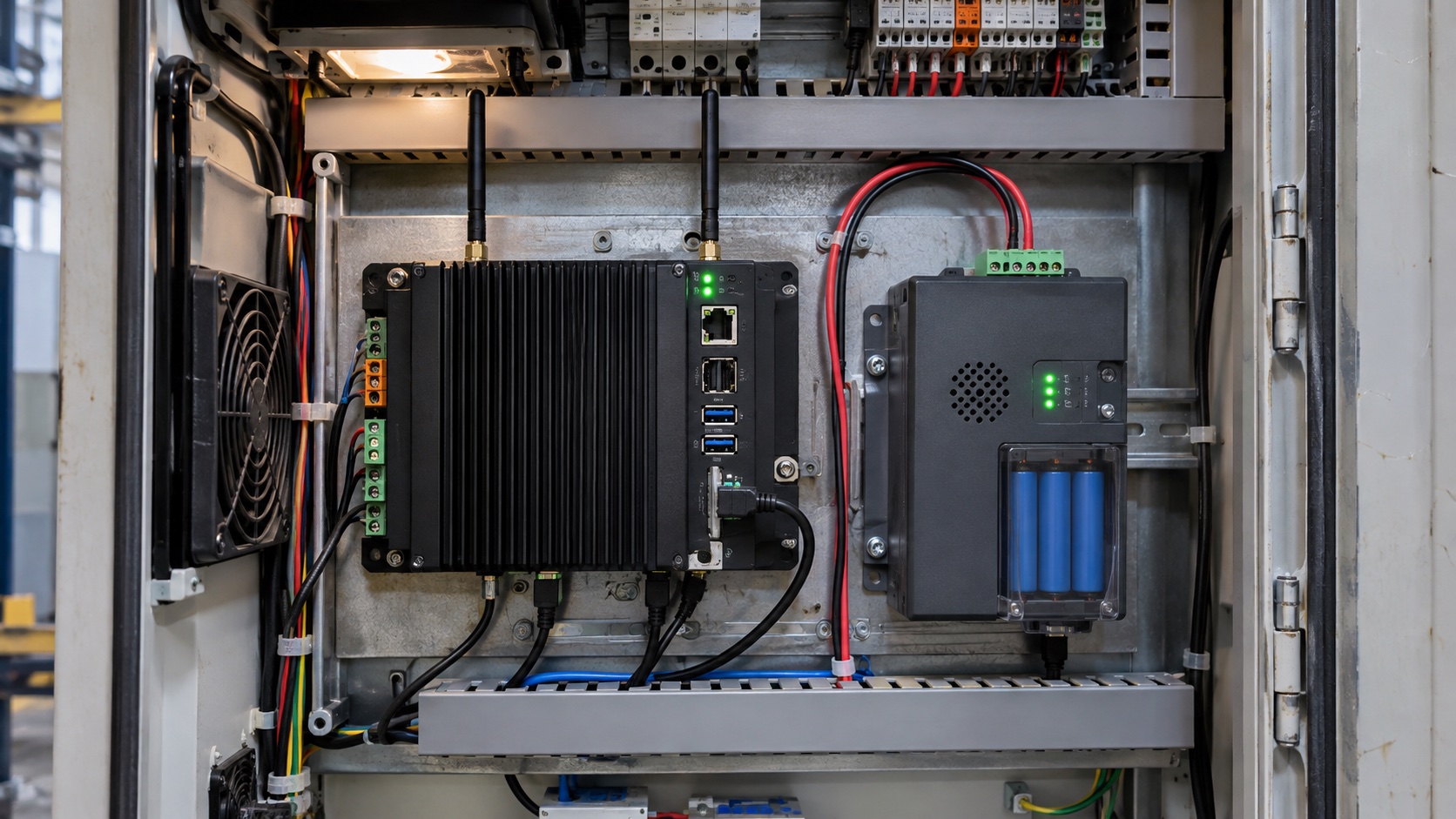
Pulling power from an Android device is easy. Proving that it recovers without losing the wrong data is harder. A unit can reboot successfully while its last transaction, update state, or peripheral configuration is inconsistent.
Power-loss design starts by deciding what must survive and what may be discarded. Then combine hardware hold-up, early power-fail detection, bounded software work, durable data structures, and recovery tests.
Define the failure contract
Separate loss of input power, a brief voltage dip, an orderly user shutdown, and an internal watchdog reset. They do not provide the same warning or leave the same hardware state.
List critical data: transaction acknowledgements, device identity, calibration, application configuration, update metadata, and queued work. Define the point at which the product promises that each item is durable.
A screen saying “saved” is a user contract. If the data is only in a process buffer, the implementation has not met that contract.
| Data class | Typical requirement | Recovery approach |
|---|---|---|
| Device identity and calibration | Must remain valid | Protected storage and verified backup strategy |
| Confirmed transaction | Must not disappear or duplicate | Durable commit and reconciliation identifier |
| Cached media | May be rebuilt | Integrity check and refetch |
| Diagnostic logs | Bounded acceptable loss | Rotation and selective persistence |
| Update state | Must select a bootable system | Verified update and rollback mechanism |
| In-progress user action | Product-specific | Resume, cancel, or explicit reconciliation |
Measure how much warning exists
A power-fail signal must arrive before the rails fall below their usable range. Measure at minimum input voltage, maximum load, low temperature where relevant, and aged energy-storage assumptions.
Do not infer shutdown time from nominal capacitance. Converter efficiency, capacitor tolerance, equivalent series resistance, voltage range, and load profile affect usable energy.
For a capacitor, an initial energy estimate is one half times capacitance times the difference between squared starting and ending voltages. Divide usable energy by load power for an idealized time, then include conversion losses and margin.
This is a sizing calculation, not proof. Capture input, regulated rails, power-fail interrupt, and software completion on the actual board.
The brownout design guide explains reset and rail behavior that must work even when graceful shutdown is impossible.
Choose what the hold-up system must finish
A few milliseconds may allow a controller to record a flag. Several seconds may allow an application to stop accepting work and close a transaction. A complete Android shutdown can take longer and vary with system state.
Choose a bounded objective. Depending on the product, preserving a small critical record and relying on robust reboot recovery may be more practical than holding the entire display and processor alive through every shutdown service.
Reduce optional load after a valid power-fail event if the hardware architecture permits it. Backlight, external USB loads, and radios can consume energy needed for data preservation.
Ensure power returns are handled. If input recovers while shutdown is underway, the device should follow a defined sequence instead of oscillating between shutdown and normal operation.
Make storage operations crash-consistent
Use transactional storage for related state and understand the durability guarantees of the database and filesystem configuration. A completed application write is not necessarily a completed device flush.
Avoid replacing configuration files in place with multiple unrelated writes. Write a complete new version, validate it, and use an appropriate atomic replacement strategy with required synchronization for the platform.
Keep checksums or version markers where they help detect incomplete records, but do not confuse detection with recovery. The system needs a valid prior copy or a reconstruction procedure.
Critical counters and queue entries should have stable identifiers. After an uncertain shutdown, reconciliation should distinguish an uncommitted action from an action completed remotely but not acknowledged locally.
Protect updates separately
System updates involve boot metadata, multiple partitions, and health checks. Use the platform’s supported update architecture rather than a shell script that overwrites the running system.
Power interruption must be tested during download, verification, writing, activation, first boot, and rollback. Each phase has a different expected result.
The Android OTA guide covers A/B and recovery concepts. Keep the power-loss test record aligned with the exact bootloader and update implementation.
Application updates also need testing. A package replacement followed by database migration can fail differently from a firmware update. Ensure the previous application cannot open a newly migrated database unless rollback compatibility is designed.
Avoid shutdown work that grows without bound
Do not compress every log, upload a backlog, or scan the full database during emergency shutdown. The device may already be under heavy I/O load.
Keep a small fixed set of actions: stop new transactions, record the power event, commit required state, quiesce selected peripherals, and signal completion. Measure the longest observed duration under stress.
Use a monotonic deadline. When the remaining energy is insufficient, take the defined minimal action rather than repeatedly retrying optional work.
Check interaction with the watchdog. A deliberate shutdown must not trigger a competing reset that interrupts the very operation being protected.
Build a power-cut test rig
Use a controlled switch and a repeatable trigger to interrupt input at selected points. Test sacrificial units and keep serial or external logs independent of the device under test.
Vary interruption duration and restoration timing. Short dips may leave peripherals partly powered, while a long outage produces a true cold start.
| Cut point | Expected result | Evidence |
|---|---|---|
| Idle | Clean restart with valid configuration | Boot and storage integrity |
| Database commit | Either prior or new valid state | Transaction and identifier checks |
| Remote request | No duplicate business operation | Server and device reconciliation |
| Update write | A bootable verified system remains | Slot and update state |
| First boot after update | Bounded recovery or rollback | Boot attempts and health result |
| Shutdown completion | Stable off state or documented restart | Rail and reset trace |
Run many cycles at different workload phases. Randomized timing finds races that fixed intervals can miss, but retain the random seed or event sequence so a failure can be reproduced.
Verify the recovery experience
A device that spends ten minutes rebuilding a cache may technically recover but fail the operational requirement. Measure power-to-useful-operation time after each fault class.
Check peripheral state as well as Android state. A modem, USB hub, printer, or external controller can remain powered through a processor reset and require its own recovery sequence.
Present uncertain transactions honestly. The UI should indicate reconciliation or operator review when the product cannot prove whether an action completed. Repeating a payment or dispensing command blindly is unacceptable.
Monitor repeated power events in the field. They may indicate an installation or supply issue that software cannot repair.
Frequently asked questions
Can Android always shut down safely after power is removed?
Only if sufficient warning and stored energy remain. Design for abrupt loss as well as graceful shutdown because some faults provide no useful warning.
Does journaling prevent all data loss?
No. It helps maintain filesystem consistency, but application transaction durability and storage-controller behavior still matter.
Is a large capacitor enough?
It must be sized against actual load, voltage range, converter behavior, tolerance, aging, and shutdown duration. Validate the complete circuit under worst conditions.
Release requirement
Keep a power-loss matrix with the promised data outcome, recovery time, and test evidence for each interruption point. Combine it with the eMMC endurance plan so extra persistence does not create uncontrolled write traffic.