
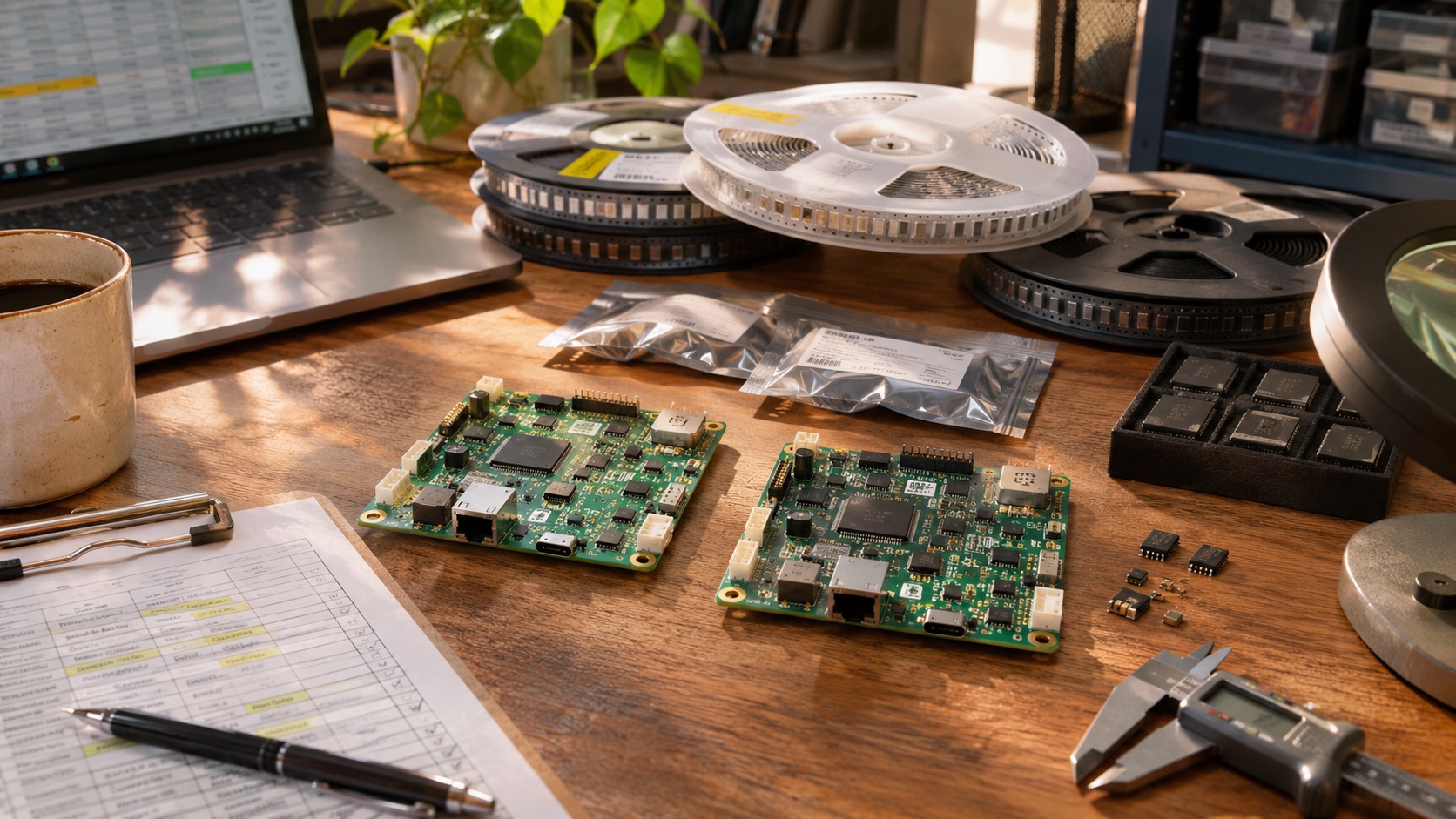
A supplier’s “form, fit, and function equivalent” notice can hide a change that affects boot timing, RF performance, thermal margin, or update reliability. The board may retain the same sales name while memory, regulators, crystals, or wireless firmware change underneath it.
Manage product change notices as engineering inputs. Every proposed change needs identity, impact assessment, validation scope, inventory disposition, and an approval record.
Establish the as-built baseline
Record the board revision, approved BOM, critical component part numbers, firmware versions, panel and cable revisions, manufacturing site, and relevant process details.
A purchasing description such as “4 GB RAM, 64 GB eMMC” is not enough to identify a qualified configuration. Exact part and revision data matter when failures cluster by lot.
Agree with suppliers on what triggers notification. Include component substitutions, die or package changes, firmware changes, manufacturing transfers, process changes, and end-of-life notices.
| Change | Possible effect | Initial review owner |
|---|---|---|
| DRAM or eMMC | Timing, boot, retention, performance | Hardware and BSP teams |
| Regulator | Transient response, heat, EMI | Power engineer |
| Wireless module or firmware | Driver, RF, reconnect, compliance | RF and software teams |
| Display or touch controller | Timing, optics, noise, permissions | Display and application teams |
| Crystal or oscillator | Timing, radio, RTC drift | Hardware team |
| Manufacturing process | Yield, solder quality, reliability | Quality and manufacturing |
Ask for complete notice information
A useful notice identifies old and new parts, reason, affected products, first changed shipment, sample availability, qualification evidence, and last-order or last-shipment dates where relevant.
Request markings and traceability methods that let incoming inspection distinguish configurations. A change that cannot be identified after assembly is difficult to manage in the field.
Clarify whether the supplier’s qualification covers your operating conditions. A general board test may not include your display, enclosure, update process, or radio arrangement.
Record unanswered questions and ownership. Do not let an incomplete email become implicit approval because production is waiting.
Classify impact without guessing
Map the change to affected requirements. A resistor substitution with equivalent tolerance and rating may need documentation review; an eMMC controller change may require extensive functional and power-loss testing.
Consider coupled effects. A more efficient regulator can still change switching noise. A new display can alter both backlight power and touch interference.
Use failure mechanisms to select tests. Avoid automatically rerunning every test, but document why omitted tests are unaffected.
The BSP evaluation guide helps identify software dependencies that can make a hardware substitution more significant than it appears.
Build a focused qualification plan
Compare old and new configurations using the same image, workload, fixtures, and environment. Keep golden samples of both.
Measure functional behavior, performance, power, thermal response, startup, sleep, recovery, and relevant environmental limits. Include boundary conditions where the changed component has the least margin.
For storage changes, review the eMMC endurance guide. For radio changes, use the antenna integration guide with the final enclosure.
| Validation stage | Purpose | Decision |
|---|---|---|
| Document review | Confirm ratings and compatibility | Accept for sample evaluation or reject |
| Bench comparison | Expose obvious behavior changes | Define deeper tests |
| Boundary testing | Check worst operating conditions | Confirm margin |
| Pilot production | Check assembly and test yield | Approve process readiness |
| Controlled field use | Observe representative deployment | Expand or hold rollout |
Keep results linked to the exact samples. “New memory passed” is not a traceable conclusion.
Control mixed inventory
During transition, old and new components may coexist in supplier stock, work in progress, finished goods, and service inventory. Define which combinations are approved.
Require lot and serial mapping. If a field issue appears, the team should identify affected units without opening every enclosure.
Decide whether one firmware image supports both configurations. If separate images are required, the factory must select and verify the correct one automatically or through a robust process.
Document rework rules. A repaired board with a new component can become a hybrid configuration that was never qualified.
Handle end-of-life decisions early
An end-of-life notice creates several options: last-time buy, qualified replacement, board redesign, platform migration, or product retirement. Compare them using demand, support horizon, storage life, cash, and technical risk.
A large last-time buy can defer redesign but creates inventory and aging exposure. Forecast uncertainty matters, especially for components with special storage requirements or limited shelf handling.
Check software support separately. A lifetime stock of boards does not guarantee kernel fixes, security patches, or toolchain availability.
The Android SBC lifecycle guide connects hardware availability with software maintenance.
Avoid approval by schedule pressure
Make the decision owner explicit. Purchasing can coordinate availability and cost, but engineering and quality should approve the technical configuration within their responsibility.
If a temporary deviation is necessary, give it a quantity, expiry, affected serial range, additional screening, and disposition plan. An open-ended deviation becomes an uncontrolled new baseline.
Record known limitations in the release notes and service documentation. Support teams need to know when behavior differs by hardware lot.
Do not accept a supplier’s testing as a substitute for product-level acceptance unless the scope and evidence actually cover your requirements.
Update production and service systems
After approval, revise the BOM, approved vendor list, work instructions, incoming inspection, fixture limits if needed, firmware mapping, and spare-parts policy.
Train the factory on visible differences and failure signatures. A new part marking can otherwise be mistaken for a counterfeit or wrong component.
Update the golden sample package and retain the previous version. Historical configurations remain relevant for installed units and warranty analysis.
Use field monitoring to compare failure rates and performance after rollout, while accounting for different environments and deployment age.
Build a supplier scorecard
Track notification lead time, completeness, sample availability, qualification quality, unauthorized changes, and response time to defects.
Discuss recurring problems with evidence. A supplier that communicates changes early may be more valuable than one offering a slightly lower price with poor traceability.
Include change-notification obligations in procurement requirements, with named contacts on both sides. Ensure notices still reach the team after personnel changes.
Frequently asked questions
Is a pin-compatible component automatically an acceptable substitute?
No. Timing, firmware, power, thermal, reliability, and process behavior can differ even when the package and pinout match.
Should every PCN trigger a full DVT cycle?
No. Use documented impact analysis to select the required regression tests. Major changes may justify broad requalification.
Is a last-time buy the safest EOL response?
It can be useful, but it adds forecast, storage, capital, and support risks. Compare it with migration and second-source options.
Approval record
Keep the notice, technical comparison, samples, tests, decision, affected serials, and implementation date together. A controlled change is one your team can identify, reproduce, and support years after the supplier’s email is forgotten.