
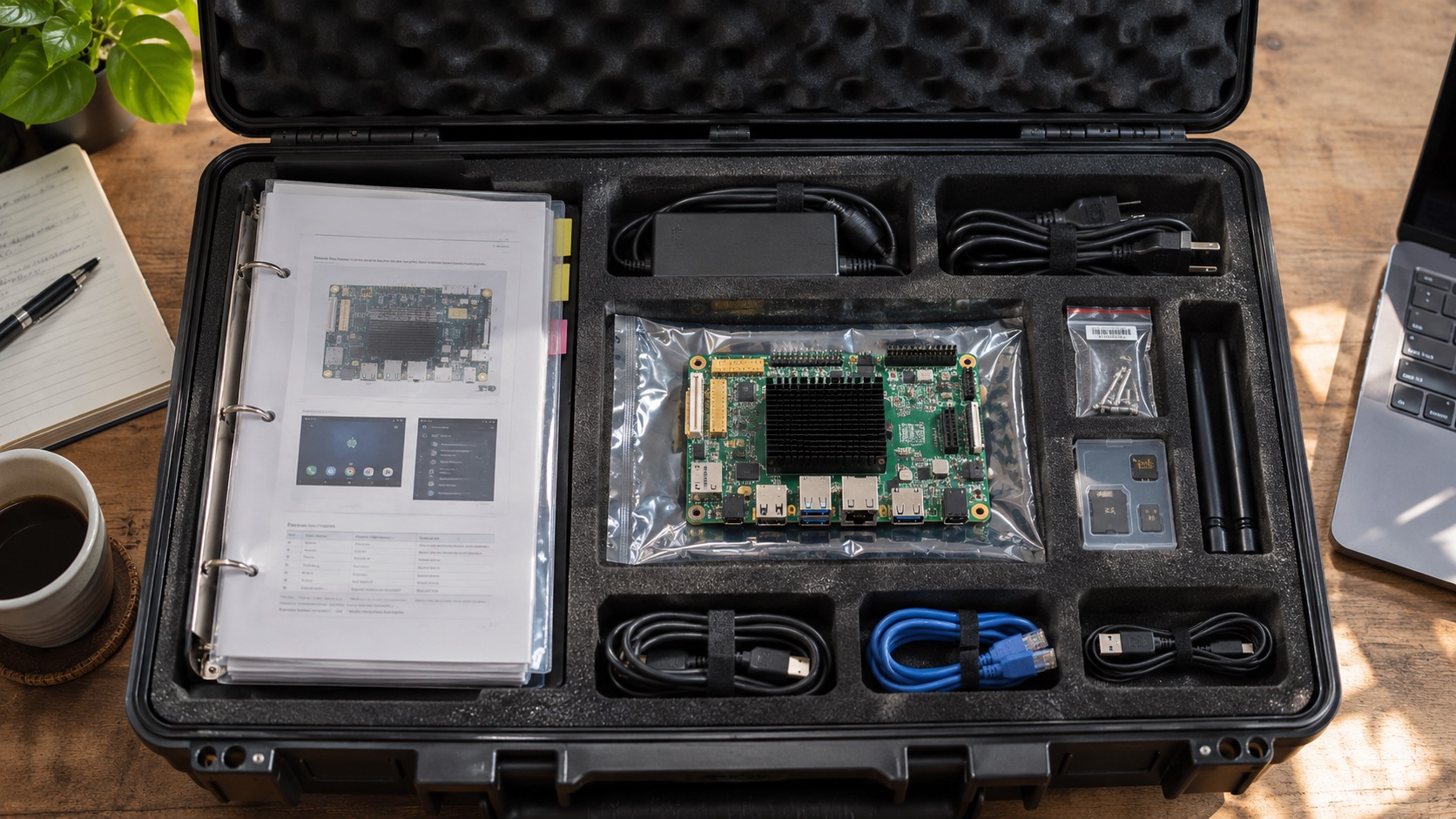
A “golden sample” sitting on an engineer’s desk is not a release baseline if nobody knows which image, cable, panel, or rework it contains. It may be the best-working prototype and still be impossible for a factory to reproduce.
A useful golden sample is a controlled reference configuration backed by a release package. The physical unit shows the intended assembly; the documents and software explain how to build, test, provision, and service it.
Define the role of each reference unit
Separate engineering reference, manufacturing reference, quality inspection reference, and service reference where their purposes differ.
An engineering unit may expose debug headers. A production reference should represent the shipped state, including security settings, labels, enclosure, and accessories.
Record serial number, hardware revision, assembly date, image identity, known deviations, and custody. Seal or mark the unit so undocumented changes are visible.
| Reference | Main purpose | Must represent |
|---|---|---|
| Engineering baseline | Reproduce and diagnose behavior | Controlled hardware and software |
| Manufacturing sample | Guide assembly and routing | Approved production construction |
| Quality sample | Compare appearance and operation | Defined acceptance standard |
| Service sample | Validate repairs and replacement parts | Supported field configuration |
| Known-fault sample | Verify test coverage | Documented, repeatable defect |
One unit can serve several roles only if those roles do not conflict.
Capture the as-built configuration
List exact board, display, touch controller, storage, wireless module, antenna, cable, power supply, thermal materials, fasteners, and enclosure revision.
Photograph cable routing, thermal pad placement, grounding, labels, and connector seating. Include views that disappear after assembly.
Record all rework. A wire modification or hand-selected component can make a sample behave differently from the released PCB and BOM.
If the reference contains a deviation, label it clearly and define which comparisons remain valid. Do not let a temporary exception silently become the manufacturing instruction.
Package software as a reproducible release
Include the bootloader, partition images, kernel and device-tree artifacts as applicable, application packages, configuration, and required flashing tools.
Record cryptographic hashes, build identifiers, source revisions, toolchain versions, and dependency versions needed for reproducibility. Store signing material through the approved secure process rather than copying private keys into a general release folder.
Provide a manifest that states what each artifact is and which hardware revisions it supports. Avoid ambiguous names such as “final-new-fixed.”
The BSP evaluation guide helps define source and maintenance access before the project reaches release.
Include the manufacturing procedure
A release package should tell the factory how to assemble, flash, provision, test, and finish the unit in the correct order.
Specify torque, adhesive cure conditions, cable routing, thermal interface placement, protective-film removal, and final cleaning where relevant.
Document factory mode entry and exit. The final station should verify the production security posture, image version, device identity, and application readiness.
The factory fixture guide covers station controls and traceability. Include its released procedure and software version in the package.
| Package section | Required content | Verification |
|---|---|---|
| Hardware | BOM, drawings, assembly data | Matches physical sample |
| Software | Images, packages, hashes, manifest | Reflash and boot successfully |
| Provisioning | Identity and configuration flow | No duplicate or missing identity |
| Test | Procedures, limits, fixture versions | Known-good and known-fault checks |
| Quality | Appearance and functional criteria | Independent inspector agreement |
| Service | Recovery and replacement instructions | Technician can follow unaided |
Define acceptance instead of relying on resemblance
A golden unit is a comparison aid, not a complete specification. Two units can look identical while differing in power, RF, or security behavior.
Keep numerical limits and test methods for critical functions. For appearance, define lighting, distance, viewing angles, and acceptable defects.
Document expected startup, error, maintenance, and offline screens. Include the behavior after network loss, power interruption, and peripheral removal.
Use the same production workload that informed DVT. A reference app displaying a logo cannot validate the shipping application’s memory or thermal behavior.
Verify the package independently
Have someone who did not prepare the release build a unit from the package. They should not need undocumented instructions from the original engineer.
Start with a clean approved board and follow the flashing and provisioning sequence. Compare hashes, identity, configuration, and test results.
Record every missing file, ambiguous step, or manual workaround. Fix the package and repeat affected steps until the process is reproducible.
This is one of the most valuable tests before PVT because it reveals assumptions hidden in personal laptops and chat history.
Preserve update and recovery evidence
Include the approved update path, rollback conditions, recovery image, and compatibility matrix. State what happens when an update is interrupted or when the application database changes.
Verify that recovery does not remove required ownership or reopen debug access. A unit that boots after repair but returns to a development state is not restored to the release baseline.
The OTA update guide provides the failure points to test. Keep those results with the corresponding release, not in a separate unversioned report.
Store and maintain physical samples
Protect reference units from moisture, electrostatic damage, battery depletion, connector wear, and unauthorized use. Define storage conditions and periodic checks.
Do not use the only golden sample for destructive troubleshooting. Keep a working comparison unit and preserve the controlled reference.
Record loans, repairs, battery changes, and firmware updates. If a reference is modified, either restore it or issue a new revision with a clear relationship to the prior one.
A worn reference can mislead production. Recheck display appearance, connector condition, and calibration before using it to judge new units.
Version the package with the product
Every approved component or software change should update the manifest and relevant tests. Keep prior releases for installed products.
Use a release identifier that maps to supported hardware and software combinations. The factory, support team, and fleet system should be able to report it consistently.
The PCN management guide explains how supplier changes enter this process.
Avoid editing a released package in place. Publish a new controlled revision and record why it changed, what was validated, and which units are affected.
Make field diagnosis possible
A service engineer should be able to compare a returned device with the correct historical baseline. Keep expected logs, power measurements, boot timing, and interface identities where useful.
Include a minimal diagnostic procedure that does not erase the customer’s state before evidence is collected. Factory reset is a recovery action, not a neutral first diagnostic step.
Provide approved spare-part combinations and configuration restoration instructions. Replacing a board without restoring calibration or device identity may create a new fault.
Frequently asked questions
Is one working prototype enough as a golden sample?
Only if it matches the released configuration and has complete traceability. Undocumented rework or development software makes it a weak production reference.
Should private signing keys be inside the release package?
No. Reference the controlled signing process and public verification information. Keep private keys in the approved secure system.
How often should the sample be updated?
Whenever the approved product baseline changes in a way relevant to its role. Preserve earlier references for supported field configurations.
Release gate
Accept the package when an independent person can reproduce the intended unit, verify its identity and behavior, and recover it through approved procedures. The physical sample and the documentation should tell the same story.